Designed by Dornaz Niknezhad — Interaction Design
●
Healthcare UX · Research Leadership · Service Design
Signify Health
× CVS Health
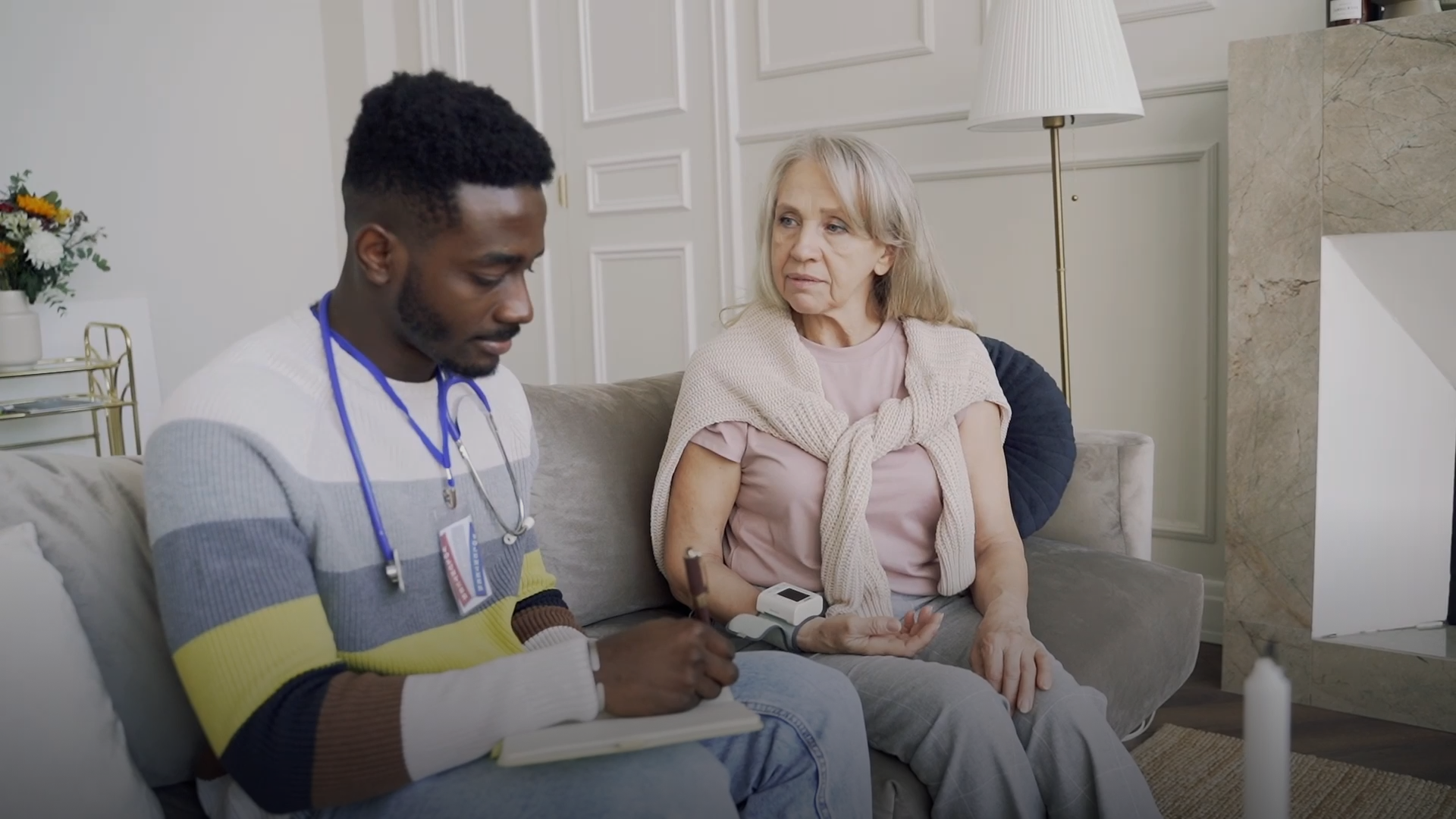
I led the research workstream for a 10-person cross-functional team — gathering, synthesizing, and prioritizing 300+ behavioral insights to redesign trust in in-home healthcare for older adults.
Role
Research Lead · UX Designer
Team
10-Person Cross-Functional
Timeline
Jan 2024 – Jun 2024
Client
Signify Health / CVS Health
300+
Behavioral Insights
Gathered, synthesized, and prioritized across all research sessions
6
Months of Research
Full discovery cycle from interviews through prioritized recommendations
10
Person Team
Cross-functional group whose research workstream I led end-to-end
01 · Overview
Signify Health provides in-home health evaluations for older adults. But members were declining visits, avoiding engagement, and losing trust — not because the service was bad, but because the experience around it was broken.
As part of a 10-person cross-functional research and design team working in partnership with Signify Health and CVS Health, I led the research workstream — responsible for structuring the discovery process, running and synthesizing user interviews, grouping and categorizing findings, and prioritizing which insights became the foundation for design recommendations.
The central question we were hired to answer: why do older adults hesitate to engage with in-home healthcare — and what would have to change for them to trust it?
This wasn't a visual design problem. It was a systems-level service design and behavioral research problem. Trust, transparency, communication, and perceived control were all breaking down at different points in the experience — and the research had to map all of it before design could touch any of it.
My Specific Ownership
✓
Led all research sessions and interview structuring
✓
Gathered and tagged 300+ behavioral insights
✓
Grouped and categorized insights into themes
✓
Prioritized findings for design recommendations
✓
Built journey maps and cognitive walkthroughs
✓
Used AI to process and synthesize massive data volume
✓
All appendix research materials produced by me
02 · The Problem
Members were declining a service that could help them — because trust broke down before the visit even started.
What Was Breaking Down
✗
Members felt anxious and confused before in-home visits — unclear what to expect
✗
Communication was transactional and robotic — no human warmth or explanation
✗
Older adults felt healthcare decisions were happening without their understanding or consent
✗
Privacy fears about strangers entering their home were never addressed
✗
No engagement strategy after the visit — continuity of care dropped to zero
✗
Caregivers and family members weren't part of the communication loop
What We Were Designing Toward
→
Members feel informed and in control before, during, and after the visit
→
Communication that explains decisions clearly and builds confidence
→
Transparency about who is coming, why, and what happens with their data
→
Trust signals embedded into every touchpoint, not just the interface
→
Continuity of care experience that follows up meaningfully
→
Caregiver and family inclusion in the experience
Trust is a Design Problem
Members didn't distrust healthcare — they distrusted an experience that gave them no information, no control, and no warmth. The interface behavior was creating anxiety, not confidence.
Older Adults as Primary Users
The core user group had different comfort levels with technology, varying health literacy, and heightened privacy concerns. Designing for them required understanding emotional states as much as task flows.
Multi-Actor Experience
Members, caregivers, clinicians, and healthcare providers all interacted with different parts of the system — but the experience was designed as if only one person was involved.
03 · Research Leadership
I led the research. All 300+ insights. Every category. Every priority.
The research workstream was mine to own. I structured the discovery process, ran the interviews, synthesized what came out of them, and made the prioritization decisions that shaped what the team designed next. This was not background research — it was the foundation everything else was built on.
300+
Behavioral Insights Synthesized
6
Research Methods Used
3
Actor Groups Mapped
AI
Used to Process Massive Insight Volume
🤖
AI-Assisted Research Synthesis
With 300+ behavioral insights across multiple research sessions, manual synthesis alone wasn't feasible at the speed the project required. I used AI tools to help process, cluster, and surface patterns across the insight data — then applied my own judgment to validate, reframe, and prioritize what the AI surfaced. This accelerated the synthesis cycle significantly without losing the human interpretation that makes research actionable.
Phase 01 · Discovery
User Interviews & Surveys
→
Semi-structured interviews with older adults, caregivers, and clinicians
→
Surveys capturing attitudes toward in-home healthcare across user groups
→
Competitive analysis of existing member communication experiences
→
Website audit of Signify Health's current member-facing platform
User Interviews
Surveys
Website Audit
Competitive Analysis
Phase 02 · Synthesis
Insight Clustering & Prioritization
→
Tagged and grouped 300+ behavioral insights by theme and user type
→
Affinity mapping to surface emotional and operational patterns
→
AI-assisted synthesis to process the full insight volume
→
Prioritized findings by impact — which insights had the most design leverage
Affinity Mapping
AI Synthesis
Prioritization
Insight Clustering
Phase 03 · Mapping
Journey Maps & Cognitive Walkthroughs
→
Multi-actor journey maps capturing member, caregiver, and clinician perspectives
→
Cognitive walkthrough of the existing Signify Health experience
→
Systems diagrams mapping relationships between patients, providers, and technology
→
Opportunity area frameworks translating research into design direction
Journey Mapping
Cognitive Walkthrough
Systems Diagrams
FigJam
04 · Research Artifacts
The work I produced — live in Figma.
All research artifacts in the appendix were produced by me. The journey maps, cognitive walkthrough, and design work represent the synthesis of 300+ insights translated into structured, reviewable documentation for the team and the client.
Research & Insights
In-depth research process, data synthesis, and supporting artifacts.
Research Details
05 · Key Insights
What 300+ insights actually told us.
01
Trust is built before the visit, not during it
Members who received clear, human communication before a visit were significantly more comfortable. By the time the clinician arrived, the trust decision had already been made — based entirely on what they'd received in writing.
02
Explainability is the missing trust signal
Users didn't distrust recommendations — they distrusted recommendations that came without explanation. "Why is this person coming? What will they do? What happens to my information?" went unanswered. Answering those questions changed everything.
03
Older adults need control, not simplification
The instinct to "simplify" for older users often removed information they wanted. They didn't need less — they needed information organized in a way that gave them a sense of agency and understanding over what was happening.
04
Caregivers are underserved actors in the experience
Adult children and caregivers often made or influenced the decision to accept a visit — but the entire experience was designed only for the member. Including caregivers in the communication loop was a high-leverage, low-effort opportunity.
05
The emotional arc matters as much as the task flow
Members went through distinct emotional states: initial anxiety → confusion → decision → vulnerability → post-visit uncertainty. Designing only for task completion missed the emotional journey that determined whether they engaged at all.
06
Post-visit continuity was completely absent
After a visit, members received no follow-up, no results summary, and no next-step guidance. The experience ended at the door closing. This was one of the highest-impact opportunity areas identified in the research.
06 · Design Themes
Six themes that structured the design recommendations.
Trust & Transparency
Every touchpoint needed to answer the question: "How do I know this is safe, legitimate, and for my benefit?" — before the member had to ask it.
Explainability
Decisions, recommendations, and processes needed to be explained — not just presented. Members who understood why were far more likely to engage.
Human-Centered Communication
Reducing robotic, transactional language. Healthcare communication that feels like it's from a person who cares, not a system that processes.
Emotional UX
Designing for the anxiety, vulnerability, and uncertainty that older adults feel when healthcare enters their personal space — not just the functional task of scheduling a visit.
Accessibility & Senior Design
Clearer information hierarchy, reduced cognitive load, larger interaction targets, and simpler language — not dumbed-down, but structured for clarity and control.
Multi-Actor Experience Design
Including members, caregivers, and clinicians in the same design lens — each with different needs, different entry points, and different relationships to trust.
07 · Deliverables
What I produced.
All appendix research materials were produced by me. The research workstream I led fed directly into the team's design recommendations and the presentation delivered to Signify Health and CVS.
Deliverable 01
Multi-Actor Journey Maps
Journey maps capturing member, caregiver, and clinician experiences — including emotional states, touchpoints, and pain points across the full in-home healthcare visit cycle.
View in Figma ↗
Deliverable 02
Cognitive Walkthrough
Step-by-step evaluation of the existing Signify Health member experience — identifying where cognitive friction, trust breakdowns, and communication failures occurred in the flow.
View in Figma ↗
Deliverable 03
Research Synthesis & Design Work
Translated 300+ behavioral insights into structured insight clusters, opportunity areas, and design direction — the foundation for the team's recommendations to the client.
View in Figma ↗
Deliverable 04
Presentation Appendix
Full research appendix for the client presentation — all materials, supporting data, insight documentation, and methodology produced by me and integrated into the team's final deliverable.
View in Figma ↗
Deliverable 05
Insight Clusters & Priority Framework
300+ insights gathered, tagged, grouped into thematic categories, and prioritized by design leverage — using AI to process the volume and human judgment to validate and frame the conclusions.
Deliverable 06
Experience Recommendations
Actionable design recommendations across 6 themes — trust signals, communication clarity, caregiver inclusion, post-visit continuity, emotional UX, and accessibility standards for older adults.
08 · Outcomes
What the research delivered.
300+
Behavioral Insights
Gathered, synthesized, categorized, and prioritized by me across 6 months of discovery research
6
Design Themes Defined
Trust, transparency, explainability, emotional UX, accessibility, and multi-actor experience — each grounded in research evidence
3
Actor Groups Mapped
Members, caregivers, and clinicians — each with distinct journey maps, emotional arcs, and experience needs
4
Major Deliverables
Journey maps, cognitive walkthrough, design synthesis, and full research appendix — all produced by me and used in the client presentation
AI
Synthesis Innovation
Used AI to process and cluster 300+ insights at scale — demonstrating an approach that's faster, more thorough, and more actionable than manual synthesis alone
CVS
Client Presentation
Research findings and recommendations presented to Signify Health and CVS Health as part of a full team deliverable
09 · What I Learned
Research is a design skill, not a pre-design step.
Trust is a design outcome, not a brand promise
You can't tell people to trust a service. You have to design the moments where trust forms — the first communication, the explanation of who is coming, the clarity of what happens next. Every one of those is a design decision, not a marketing decision.
AI makes research faster without making it cheaper
Using AI to process 300+ insights didn't replace judgment — it freed it up. The machine clustered patterns; I decided which patterns mattered and why. That combination is faster and more thorough than either alone. I'd use this approach on every large-scale research project going forward.
Emotional UX is the hardest kind to get right
Designing for anxiety, vulnerability, and hesitation required understanding emotional states that most UX frameworks don't model well. Journey maps that only track tasks miss the most important data — how the person feels at each step, and whether that feeling makes them continue or stop.
Systems thinking applies to service design too
The in-home healthcare experience wasn't broken at one touchpoint — it was broken at the level of how all the actors, systems, and communications related to each other. Fixing one screen wouldn't fix anything. You had to understand the whole system before designing any part of it.
Let's work together.
I work best at the intersection of research, complexity, and real human impact, whether that's a consumer health platform, a regulated enterprise product, or something entirely new. If you're building something that matters to the people who use it, let's talk.


More Projects
Nura Sleep Platform
Health · AI · Consumer
Adaptive Intelligence Layer for Personalized Sleep
M.A. thesis — 1 year of sleep science research validated with 50+ users
Octolux Platform
Enterprise · Embedded · End-to-End
Modular Industrial UX Ecosystem
Led end-to-end — 73% faster development, #1 award-winning HMI
Tundra HMI
Systems Design · Research · HMI
Safety-Critical HMI for Commercial Refrigeration
End-to-end redesign — guided 4-step experience replacing 10-step memorization
© 2025 Portfolio. All rights reserved.
Privacy Policy
Terms of Service